
For prospecting, I was opening sites one by one to guess their marketing stack. I built an engine with Scrapy that detects these technologies across thousands of domains, by accumulating signals rather than searching for a word in the HTML.
The problem
Inspect the source code, look at loaded scripts, hunt for marketing tags: I was doing this by hand for every company. Yet a website says a lot:
| Detected signal | What it often tells you |
|---|---|
| Klaviyo | Modern e-commerce stack |
| HubSpot | Inbound / CRM approach |
| Segment | Data culture |
| Heavy GTM usage | Tracking that’s become hard to maintain |
| No CMP | Low GDPR maturity |
Existing tools didn’t fit:
| Tool | Main problem | |
|---|---|---|
 |
BuiltWith | Closed, no clean API, expensive at scale |
 |
Wappalyzer | Browser extension-oriented, poorly suited to automation |
Above all, I wanted to understand how detection worked: add my own signatures, analyze false positives, plug everything into other systems. It all started on my Windows PC, with Python, Scrapy and a few JSON files.
From an if to a bundle of signals
The first version fit in two lines:
if "hubspot" in html:
    print("HubSpot detected")
Then came dynamically injected scripts, shared CDNs, technologies visible only through cookies, JS frameworks returning nearly empty HTML. The question became: do several independent elements strongly suggest HubSpot?
flowchart TD
    A[Domain list] --> B[Scrapy spider]
    B --> C[HTML] & D[Scripts] & E[Headers] & F[Cookies] & G[Meta tags]
    C & D & E & F & G --> H[Signature engine]
    H --> I[Scoring]
    I --> J[Detected technologies]
    J --> K[JSON export] & L[Supabase] & M[n8n workflows]
Scrapy detects nothing: it collects signals, the logic lives elsewhere. I chose it because it handles several hundred pages/minute locally without JS rendering, with retries, throttling, concurrency and pipelines built in. Playwright alone was too heavy, Selenium too slow, requests + BeautifulSoup only good for one-off jobs.
Signatures and scoring
A first-version signature was "html": "hubspot": mass false positives, no notion of confidence. Today, each technology combines several types of evidence:
{
  "name": "Klaviyo",
  "html": ["klaviyo"],
  "script": ["static.klaviyo.com"],
  "cookies": ["__kla_id"],
  "confidence": { "html": 0.10, "script": 0.30, "cookie": 0.45 }
}
Scoring adds up the weights, capped at 1.0. A cookie is very reliable (someone had to install it), a CDN script reliable but sometimes shared, a word in the HTML may come from editorial content. I tested more statistical approaches: mostly, they made the system harder to debug. I stuck with readable scoring.
Result on one domain: Shopify at 0.97 (cdn.shopify.com, _shopify_y, shopify-checkout), Klaviyo at 0.91 (static.klaviyo.com, __kla_id). Enough to score a company’s tech maturity, build ICPs or track stack changes.
What broke
Modern JavaScript
On some Next.js sites, Scrapy literally got <div id="__next"></div>: everything else arrived after hydration, and some technologies became invisible. The compromise: a conditional Playwright fallback, triggered only when detection is insufficient.
| Mode | Pages/min (approx.) | RAM |
|---|---|---|
| Scrapy only | ~300-400 | Low |
| Scrapy + Playwright | ~20-50 | High |
The hard part wasn’t the code but deciding when to trigger the fallback, on which domains and with which timeouts. It’s the most important trade-off in the project, and it remains hard to scale.
Dirty data and false positives
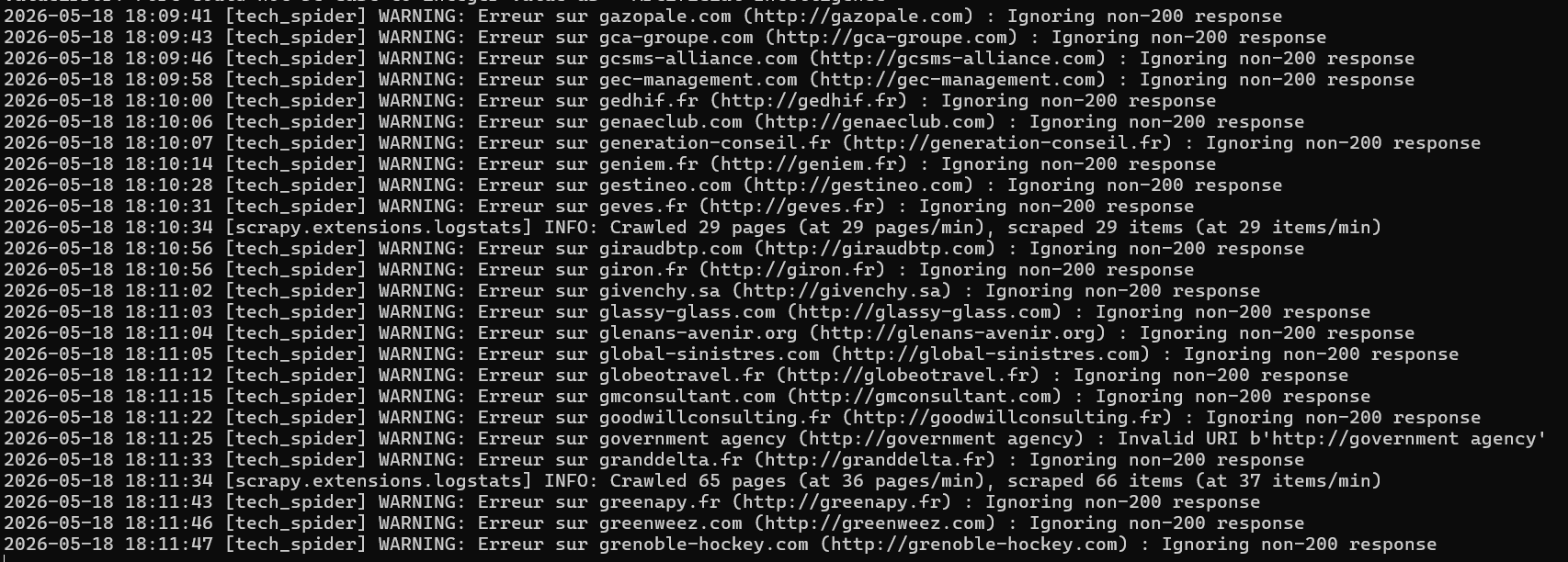
Absurd redirects, invalid certificates, timeouts, anti-bot protection, broken HTML, strange encodings: handling edge cases takes more time than the business logic.
False positives
The word segment can mean Segment CDP, a word in the content or a URL slug. Same problem with shared CDNs (Cloudflare, jsdelivr, Google APIs). Detecting fewer technologies with reliable signals is better.
After several thousand domains: lots of half-broken sites, far more WordPress than expected, very repetitive stacks by industry, and dozens of dead legacy scripts.
What I would do differently
My signatures ended up as signatures.json, signatures_v2.json, signatures_final_final.json. Today I would organize them by category (/crm/hubspot.json, /marketing/klaviyo.json…) with validation from the start. And I tested by hand on random domains for too long: you need a list of reference domains with a known stack, HTML snapshots and regression tests, because a technology can change CDN or script overnight.
Key takeaways
I thought I was building a technology detector; mostly, I built a web signal collection system, which only sees what leaks on the frontend (backend and infrastructure stay invisible). An understandable, stable pipeline beats a “smart” system that’s impossible to maintain.